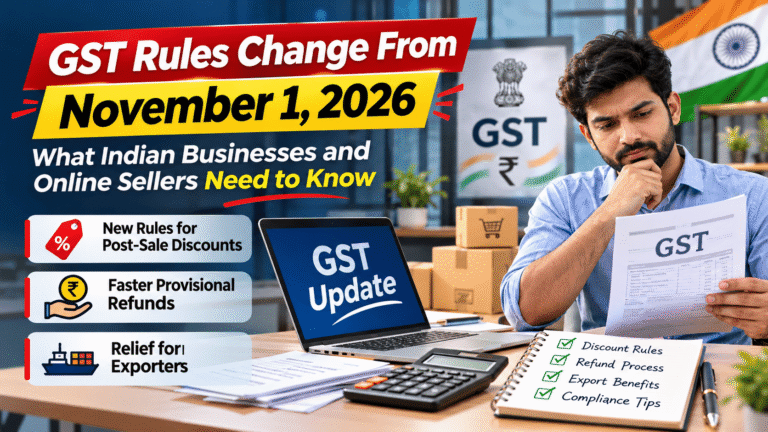
India has introduced important changes to its Goods and Services Tax (GST) framework from November 1, 2026. The changes cover post-sale discounts, provisional tax refunds for eligible businesses, and certain refund rules for exporters. These measures are intended to simplify tax procedures and help businesses manage their working capital more efficiently.
The changes are particularly relevant for manufacturers, distributors, retailers, exporters, and companies that regularly offer discounts to dealers or customers. Small business owners should also understand the difference between the legal amendments taking effect today and the other GST reforms being introduced in phases.
The Finance Ministry’s notification, reported by Reuters and other business publications, confirms November 1 as the effective date for the relevant amendments under the Finance Act, 2026. The changes follow recommendations made at the 57th meeting of the GST Council on October 8, 2026.
Here is a detailed explanation of the changes, who may benefit, and what businesses should keep in mind.
Table of Contents:
- What Are the New GST Changes From November 1?
- New Rules for Post-Sale Discounts
- Faster Provisional Refunds for Eligible Businesses
- Important Relief for Exporters
- How the Changes Could Help Small and Large Businesses
- What Should Business Owners Do Now?
- Other GST Reforms to Watch
- Frequently Asked Questions
- Conclusion
- Sources and References
1. What Are the New GST Changes From November 1?
The latest amendments focus on making certain GST procedures more flexible and improving access to eligible refunds.
The key changes concern three areas. First, businesses have greater flexibility in how eligible post-sale discounts are treated for GST purposes. Second, provisional refunds have been extended to eligible cases involving an inverted duty structure. Third, the minimum refund threshold of ₹1,000 has been removed for a specific category of export refunds.
According to Reuters’ report on October 27, 2026, the amendments are intended to ease GST compliance for businesses offering discounts after a sale and improve access to provisional refunds.
It is important to understand that these changes do not mean GST rates have been reduced across all products and services. They primarily concern tax procedures, the calculation of taxable value in qualifying discount arrangements, and the availability of refunds.
Businesses should review the provisions relevant to their activities rather than assume that every GST rule has changed.
2. New Rules for Post-Sale Discounts
One of the most important changes concerns discounts offered after a sale has already taken place.
In India, manufacturers and suppliers commonly offer discounts to distributors, dealers, and retailers. These discounts may depend on sales targets, purchase volumes, promotional schemes, or other commercial arrangements.
For example, a manufacturer might offer a dealer an additional discount after the dealer purchases a particular quantity of products during a month. Such an arrangement can affect the final commercial value of the transaction and the supplier’s GST calculations.
Under the earlier framework, excluding certain post-supply discounts from the taxable value required conditions relating to an agreement made at or before the time of supply and a link to the relevant invoices, alongside the applicable input tax credit requirements.
From November 1, the amended provisions remove the requirement for the discount to have been established through an agreement entered into at or before the time of supply. Eligible discounts can qualify for exclusion from the taxable value through the relevant GST credit note mechanism, subject to the recipient reversing the corresponding input tax credit.
This does not mean that every discount automatically reduces GST liability. Businesses must satisfy the applicable legal requirements and maintain proper documentation.
Why Is This Change Important?
The amendment could make commercial arrangements easier for businesses that offer performance-based discounts after the original invoice has been issued.
Industries such as fast-moving consumer goods, pharmaceuticals, retail, and consumer durables frequently use dealer incentives and volume-based discount schemes. Greater flexibility may help these businesses manage such arrangements without the same requirement for a prior agreement.
However, suppliers should review their existing credit note procedures and ensure that the recipient’s corresponding input tax credit is handled correctly.
The change also makes it important for businesses to coordinate with their dealers and distributors. Both parties should understand how eligible discounts will be documented and reflected in their GST records.
3. Faster Provisional Refunds for Eligible Businesses
Another important amendment concerns businesses that have accumulated input tax credit but face delays in receiving eligible refunds.
Input tax credit, commonly called ITC, refers to credit for eligible GST paid on business purchases. Businesses can use eligible ITC to offset their output tax liability, subject to the applicable provisions.
An inverted duty structure can arise when the GST rate on inputs is higher than the rate on the finished goods or output supplies. In certain circumstances, this can result in accumulated unutilised ITC.
For eligible businesses, accumulated credit can put pressure on working capital because money paid towards inputs remains tied up in the tax system.
The amendments extend the provisional refund mechanism to eligible refund claims involving an inverted duty structure.
According to the Press Information Bureau’s explanation of the GST Council’s refund reforms, the first phase provides for automated provisional sanction of 90% of the claimed amount for qualifying, system-identified low-risk refund claims involving zero-rated supplies or an inverted duty structure.
The mechanism is subject to eligibility requirements and exclusions. It does not mean that every business submitting a refund application will automatically receive 90% of its claim.
How Could Faster Refunds Help Businesses?
Consider a manufacturer that has accumulated eligible input tax credit because the GST paid on its inputs exceeds the tax collected on its output supplies.
If the business qualifies for a provisional refund, receiving part of the eligible amount earlier could help it manage operating expenses, supplier payments, inventory purchases, and other working capital requirements.
The final refund remains subject to the applicable scrutiny and legal conditions.
Businesses should therefore ensure that their refund applications are complete, their tax records are accurate, and their claims meet the relevant requirements.
4. Important Relief for Exporters
Exporters are another group that should examine the latest amendments carefully.
Indian businesses selling goods internationally may use different tax mechanisms depending on the nature of the export transaction. Some eligible exporters claim refunds through the zero-rated supply framework, while others export goods after paying the applicable tax and subsequently seek a refund.
The Finance Act, 2026, also removes the minimum refund threshold of ₹1,000 for refund claims relating to goods exported outside India with payment of tax.
This is a specific change, not a blanket removal of the minimum refund threshold for every GST refund category.
For businesses involved in exports, even procedural details can matter because they affect the cost and administration of international transactions.
Exporters should review the rules applicable to their particular export method and ensure that their claims are filed correctly.
They should not assume that the amendment removes other documentation requirements or eligibility conditions.
5. How the Changes Could Help Small and Large Businesses
The practical effect of the new rules will depend on the type of business, the way it handles discounts, and whether it qualifies for refunds.
For manufacturers and distributors, the revised treatment of eligible post-sale discounts could make commercial incentive arrangements easier to administer.
For businesses facing an inverted duty structure, provisional refunds may improve access to working capital when their claims qualify under the revised framework.
For eligible exporters, the removal of the minimum refund threshold in the specified category could make smaller refund claims possible without the earlier minimum amount restriction.
These benefits should not be confused with a direct reduction in GST rates or an automatic cash benefit for every registered taxpayer.
A business that does not offer qualifying post-sale discounts, does not have an eligible refund claim, or does not fall within the relevant export category may see little immediate effect from these particular amendments.
The most useful step is to identify which provisions apply to the business and update the relevant accounting and compliance processes.
6. What Should Business Owners Do Now?
Businesses should take a few practical steps to prepare for the revised provisions.
First, review the treatment of discounts offered after the original sale. If the business issues GST credit notes for qualifying discounts, its accounting and tax teams should understand the amended requirements and ensure that corresponding input tax credit adjustments are handled correctly.
Second, review outstanding refund claims. Businesses affected by an inverted duty structure should check whether their claims meet the conditions for provisional refunds and whether any exclusions apply.
Third, exporters should identify whether their transactions fall within the specific refund category affected by the removal of the ₹1,000 minimum threshold.
Fourth, keep invoices, credit notes, purchase records, and supporting documents properly organised. Clear records can help businesses demonstrate that their claims satisfy the applicable requirements.
Finally, consult the latest notifications, circulars, and official GST guidance before changing tax filings or accounting procedures. Some GST Council recommendations are being implemented in phases, and not every proposed reform necessarily takes effect on the same date.
For complicated cases, businesses should seek advice from a qualified tax professional rather than relying solely on general news reports.
7. Other GST Reforms to Watch
The 57th GST Council meeting also discussed a wider set of measures intended to simplify registration, refunds, and compliance.
The Press Information Bureau’s announcement dated October 8, 2026, includes recommendations concerning simplified GST registration for eligible small sellers operating through e-commerce platforms, improved refund processing, and changes to compliance procedures.
These broader measures are important, especially for small businesses selling products online or operating across different states.
However, the Council’s recommendations should be distinguished from the specific statutory amendments taking effect on November 1. Different measures may require separate notifications, rule changes, or phased implementation.
Online sellers should therefore check the current requirements that apply to their registration and business operations before making changes.
8. Frequently Asked Questions
Do GST rates change for all products from November 1, 2026?
No. The amendments discussed in this article primarily concern post-sale discounts, certain refund mechanisms, and a specific export refund threshold. They do not represent a general reduction in GST rates across all goods and services.
Will every business receive a faster GST refund?
No. The provisional refund mechanism applies to eligible claims and is subject to the prescribed conditions, risk assessment, and exclusions. Businesses must satisfy the applicable requirements.
Can businesses now offer discounts after a sale?
Businesses can offer commercial discounts, but their GST treatment depends on the applicable provisions. The amended rules provide greater flexibility for qualifying post-sale discounts through the relevant credit note mechanism and subject to the corresponding input tax credit requirements.
Does the ₹1,000 refund threshold disappear for all GST refunds?
No. The amendment removes the threshold for the specified category of refund claims relating to goods exported with payment of tax. It should not be interpreted as removing the minimum threshold for every refund category.
Where can businesses check the official GST rules?
Businesses should consult official publications from the Ministry of Finance, the Central Board of Indirect Taxes and Customs, the GST Council, and the Press Information Bureau. They should also review the relevant statutory amendments and notifications before making compliance decisions.
9. Conclusion
The GST changes taking effect from November 1, 2026, are important for Indian businesses that offer post-sale discounts, accumulate eligible input tax credit, or export goods after paying tax.
The revised discount provisions provide greater flexibility for qualifying commercial arrangements, while the provisional refund changes may help eligible businesses manage working capital more effectively. The removal of the minimum refund threshold for a specified export category is another targeted change.
However, businesses should not assume that all refund claims will be approved automatically or that every discount will qualify for a reduction in taxable value.
The practical benefit will depend on the nature of the transaction, the applicable legal conditions, and the quality of the supporting documentation.
For business owners, the best approach is to understand which changes apply to their operations, review their accounting procedures, and rely on official GST notifications for final compliance decisions.
As India’s tax administration continues to introduce procedural reforms, staying informed and maintaining accurate records will remain essential for businesses of every size.
10. Sources and References
The following publications and official government sources were consulted to verify the developments discussed in this article:
- Press Information Bureau (PIB), Government of India — Recommendations of the 57th Meeting of the GST Council, published October 8, 2026.
- Press Information Bureau (PIB), Government of India — Frequently Asked Questions on GST refund reforms, published October 9, 2026.
- Reuters — Report on India’s GST changes taking effect November 1, published October 27, 2026.
- The Times of India — Report on GST changes from November 1, including registration, refunds, and discount rules, published October 31, 2026.
- Mint — Report on changes to post-sale discounts and export refunds, published October 27, 2026.
- Business Today — Report on the Finance Ministry’s notification of GST changes effective November 1, published October 27, 2026.